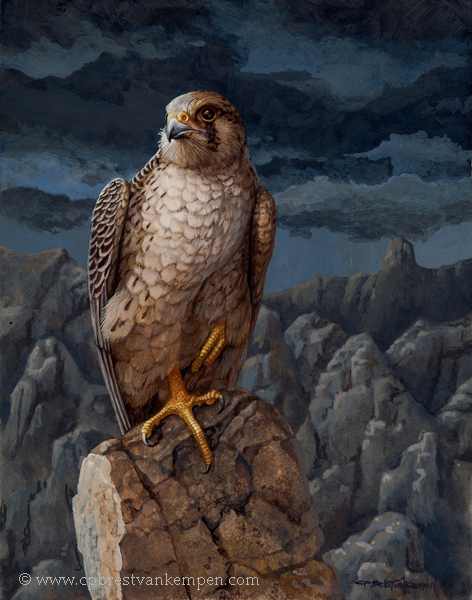
 acrylic on illustration board 14" x 11" $4,000. |
In 1925, three pale, unusual-looking young falcons were removed from an eyrie in southern Chile. They ended up at the Münster Zoo, and one was examined by ornithologist Otto Kleinschmidt, who initially mistook it for a Barbary Falcon (Falco pelegrinoides) and doubted the bird's South American origin. But in 1929, he described it as a new species, F. kreyenborgi, after the falconer who had brought the bird to his attention. Taxonomists argued and puzzled over the affinities of these birds, and it wasn’t until the early 1980s that Ellis, Glinski and Roundy, along with C. M. Anderson and Cesar Peres Garat discovered mixed pairs of typical Peregrines with Kleinschmidt's as well as normal Peregrine pairs yielding phenotypical Kleinshmidt's. F. kreyenborgi was not a valid species after all, but instead just an alternate color morph peculiar to that population of Peregrines. In retrospect, it seems obvious that this should have been the case, but it was common knowledge at the time that Peregrines were a monomorphic species, and such dogma can effectively block our vision. The names “Kleinschmidt's Falcon” and Falco kreyenborgi have been relegated to the history books; the preferred name for the morph is “pallid falcon,” but those old monikers still serve as effective reminders to always give the obvious the consideration it deserves. (In recent years, a couple of very similar-looking Peregrines have been documented in arctic North America.) |